


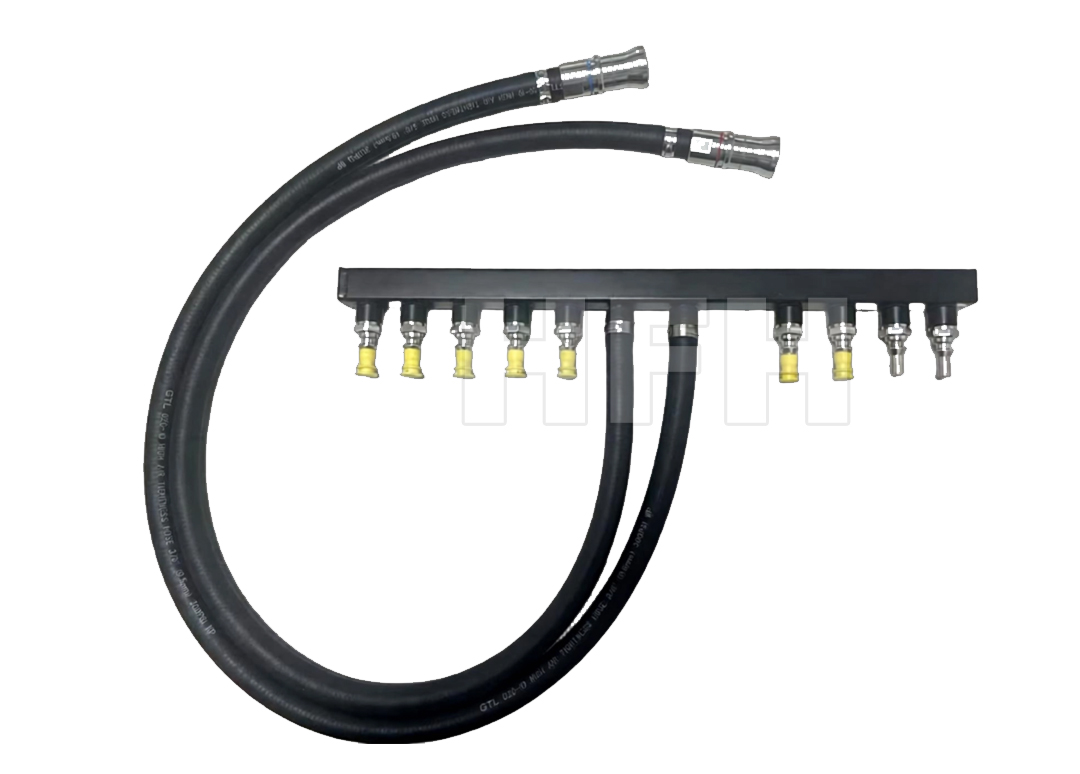


The inner manifold (Inner-Manifold) in the chassis is a core component of the liquid cooling system, responsible for distributing the coolant within the chassis. Its main function is to precisely divert the coolant from the main pipeline to various cooling nodes (such as server cold plates) inside the chassis, and then collect the return liquid to form a complete cooling loop.
Key features and technical parameters:
The water distributors inside the chassis are usually made of corrosion-resistant materials such as stainless steel (e.g. 304, 316L) or copper alloys to adapt to the cooling liquid environment. The surface roughness (Ra) of the internal flow channels is generally required to be controlled below 0.8 µm (up to 0.4 µm or 0.2 µm in high-performance scenarios), to reduce flow resistance, minimize particle retention and reduce the risk of corrosion; the flatness of the interface needs to be within 0.01mm/100mm to ensure sealing reliability and prevent leakage. The design of the water distributor supports multiple node connections (the number of nodes can cover 2 to 48), and can be configured with a single-row or double-row tube structure based on the chassis space, with a wall thickness of typically 2 to 4mm, and high processing accuracy (such as the position accuracy of the branch pipes ±0.1mm).
Function and Purpose:
As the "distribution center" of the liquid cooling system, the water distributor ensures that the coolant is evenly distributed to each heat dissipation component, thereby enhancing the cooling efficiency. Its sealing design (such as O-rings or metal plane seals) and anti-leakage capability are crucial for ensuring the safety of the equipment inside the chassis. At the same time, the smooth surface of the internal flow channels helps maintain the cleanliness of the coolant and reduces the maintenance requirements.
Application scenarios and selection considerations:
This component is widely used in liquid cooling cabinets of data centers, high-performance computing equipment, etc. When selecting, special attention should be paid to the material compatibility (matching the type of cooling fluid), the sealing flatness, and the welding process (such as combining laser welding with manual welding to enhance reliability); customized requirements (such as the number of nodes, thread forms) can also be met.
`
Customized
Provide one-stop service
Radiator / Heat sink / Ultrathin heat pipe / Vapor Chamber / Liquid cooling plate

Requirement Communication
ONE

Determine solution
TWO

Concluding a contract
THREE

Down payment
FOUR

Proofing and validation
FIVE

Mass production processing
SIX

QC & QA
SEVEN

Logistics distribution
EIGHT

Customer satisfaction acceptance
NINE

Customer service
TEN


